Introduction
The Microsoft .NET Framework is a pillar in the field of .NET application development. It gives programmers a strong and flexible base on which to create a variety of applications. The Common Language Runtime (CLR), a vital element that makes .NET development feasible, is at the centre of this framework. We’ll examine Microsoft .NET CLR’s definition, importance, and operation in this post.
Understanding Microsoft .NET CLR
The CLR is the .NET Framework’s execution engine. It oversees running code that has been compiled from a variety of languages and offers critical functions, including memory management, security, and exception handling. The duty of the CLR is to fill the gap between machine code and programming languages. Machine code is what a computer’s processor can understand (1’s and 0’s). C#.NET and VB.NET are some examples of programming languages.
Functionality and Features
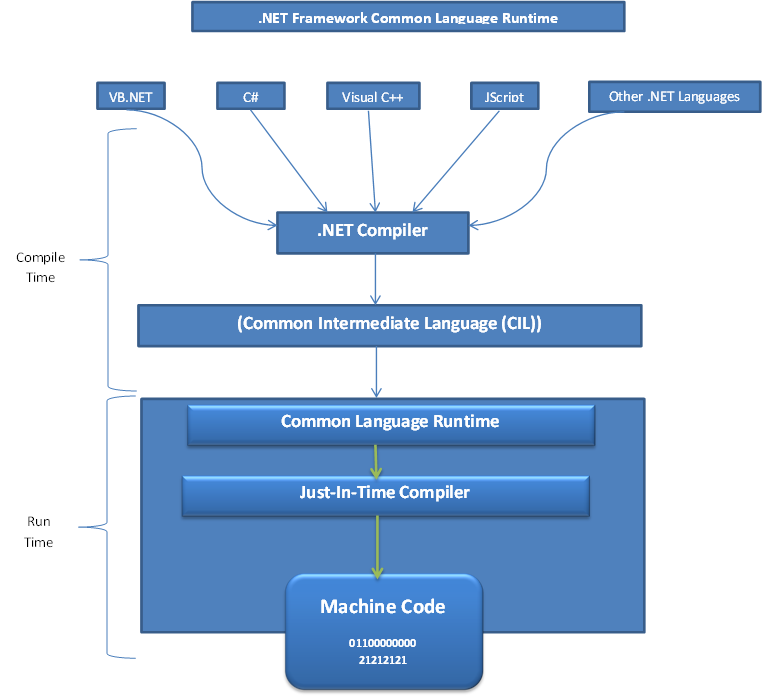
Just In Time (JIT) Compilation: This is one of the key features of CLR. A .NET application is not directly translated into machine code. Instead, it is first compiled into an intermediate language. It is known as Microsoft Intermediate Language (MSIL) or Common Intermediate Language (CIL). CLR translate the Intermediate Language into machine code at runtime, depending on the platform. This process is known as “Just In Time” compilation, and it ensures that the code is optimised for the target platform.
Memory Management: CLR takes care of the memory allocation of the application and garbage collection. To avoid crashes and memory leaks, CLR ensures that the allocation and deallocation of objects are done correctly. Due to this process, the application process is simplified and reduces the chances of having memory-related bugs.
Security: This is one of the major challenges during the development process. CLR provides code access security and role-based security, which are robust features to protect applications and data. Code access security allows developers to define permissions and access levels for code.
Exception Handling: This is a main concern when developing an application. CLR has a well-defined mechanism which simplifies the error and exception-handling process. Due to this behaviour, developers can detect and handle exceptions and errors easily. It helps us to develop stable applications and handle unexpected issues.
Language Interoperability: This feature allows developers to build modules in different .NET programming languages within the same application. This is because any programming language that targets the .NET Framework compiles to CIL, which is ultimately executed by CLR.
How CLR Works
Compilation: Code written in high-level languages like C# and VB.NET is converted into MSIL by the language-specific compiler.
Just In Time Compilation: CLR is responsible for executing the MSIL code at runtime. During this process, the JIT compiler translates the MSIL code into machine code. This will optimise the code for the specific hardware and platform.
Execution: The managed environment of the CLR handles the compiled code. CLR takes care of memory management, exception handling and security checks during code execution.
Garbage Collection: This is an automatic process done by the CLR. CLR is reclaiming unused objects and is not using the memory from them.
Conclusion
In conclusion, the .NET Framework’s Common Language Runtime (CLR) is at its core and offers crucial services for the execution of .NET programs. It is essential to .NET development’s efficiency, security, and accessibility. With capabilities like memory management, security, exception handling, and just-in-time compilation, CLR streamlines the development process and assures the dependability of .NET programs.
Understanding CLR’s purpose and role is essential as you enter the realm of .NET programming. The CLR will handle the challenging aspects of execution, memory management, and security. Programmers can use any language for their application. The .NET Framework’s success continues to be largely attributed to its potent runtime engine, which enables programmers to build reliable and adaptable programs.